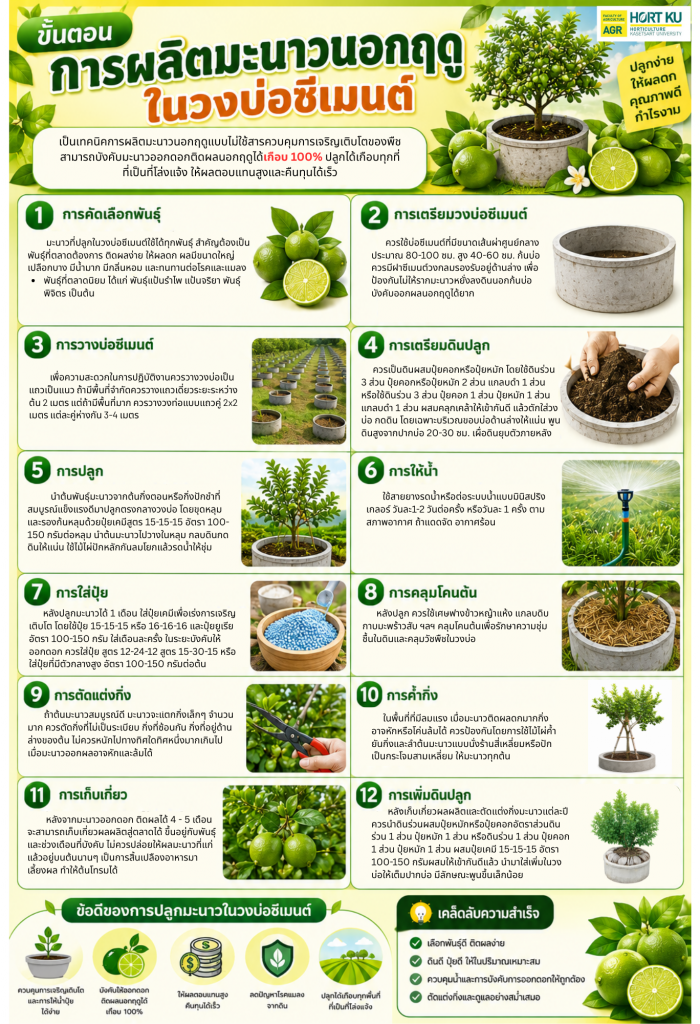
Steps for Producing Out-of-Season Limes in Cement Rings
Easy to grow, highly productive, good quality, and highly profitable.
This is a technique for producing out-of-season limes without using plant growth regulators. It can force limes to flower and fruit out of season with almost 100% success. They can be planted in almost any open area, providing high returns and a quick payback.
1. Variety Selection
Any lime variety can be grown in cement rings. Importantly, it must be a variety in market demand, easy to fruit, highly productive, large in size, thin-skinned, juicy, aromatic, and resistant to diseases and insects.
Popular market varieties include Pan Ramphai, Pan Jariya, and Phichit varieties, etc.
2. Preparing Cement Rings
Use cement rings with a diameter of about 80-100 cm and a height of 40-60 cm. The bottom of the ring should have a circular cement lid supporting it underneath to prevent lime roots from penetrating the soil outside the ring, which makes forcing out-of-season fruiting difficult.
3. Placing Cement Rings
For operational convenience, the rings should be placed in orderly rows. If space is limited, place them in a single row with a 2-meter spacing between plants. If there is ample space, arrange them in double rows of 2×2 meters, with 3-4 meters between each pair.
4. Preparing Planting Soil
It should be soil mixed with manure or compost. Use 3 parts loam, 2 parts manure or compost, and 1 part rice husk ash; OR 3 parts loam, 1 part manure, 1 part compost, and 1 part rice husk ash. Mix well, then scoop into the ring. Compact the soil, especially around the lower edges. Mound the soil 20-30 cm above the rim of the ring to allow for future soil subsidence.
5. Planting
Take a healthy lime sapling from air layering or stem cutting and plant it in the center of the ring. Dig a hole and line the bottom with chemical fertilizer formula 15-15-15 at a rate of 100-150 grams per hole. Place the lime plant in the hole, cover with soil, and compact it firmly. Insert a bamboo stake to prevent wind sway and water thoroughly.
6. Watering
Use a watering hose or connect a mini-sprinkler system, watering once every 1-2 days, or once a day depending on the weather conditions (e.g., if it is sunny and hot).
7. Fertilizing
One month after planting, apply chemical fertilizer to accelerate growth using formulas 15-15-15 or 16-16-16 and urea fertilizer at a rate of 100-150 grams, applied once a month. During the flower-forcing stage, apply formula 12-24-12, 15-30-15, or fertilizers with a high middle number (Phosphorus) at a rate of 100-150 grams per plant.
8. Mulching
After planting, use rice straw, dry grass, raw rice husks, chopped coconut husks, etc., to mulch the base of the plant to retain soil moisture and control weeds inside the ring.
9. Pruning
If the lime tree is healthy, it will produce many small branches. Prune disorderly branches, overlapping branches, and lower branches. The tree shouldn’t be overly heavy on any one side, as it may break and fall when bearing fruit.
10. Branch Propping
In windy areas, heavy fruiting can cause branches to break or the tree to fall. Prevent this by using bamboo to prop up the branches and trunk in a square scaffold or triangular teepee shape for every tree.
11. Harvesting
After flowering, fruits will set and can be harvested for the market in 4-5 months, depending on the variety and the forced month. Do not leave overripe limes on the tree for too long, as it wastes nutrients and weakens the tree.
12. Adding Soil
After harvesting and annual pruning, add a soil mixture. Use 1 part loam and 1 part compost; OR 1 part loam, 1 part manure, and 1 part compost. Mix with 100-150 grams of 15-15-15 chemical fertilizer. Mix well and fill the ring to the rim, slightly mounded.
Advantages of Growing Limes in Cement Rings
Easy to control growth, watering, and fertilizing.
Can force out-of-season flowering and fruiting with almost 100% success.
Provides high returns and a quick payback.
Reduces soil-borne diseases and pests.
Can be planted in almost any open area.
Tips for Success
Choose good varieties that fruit easily.
Use good soil and fertilizer in appropriate amounts.
Properly control watering and flower forcing.
Prune and maintain regularly.